
How to Protect Your Mechanical Watch During Sports
A Data-Driven, Practical Field Guide
Let’s be honest—mechanical watches really don’t like repetitive impact during sports. Any activity that puts more than 5g of acceleration on your wrist—ball games, weightlifting, running—just take the watch off. It’s that simple. If you insist on wearing a mechanical piece during high-intensity exercise, that hairspring (0.03–0.05mm thick, thinner than a human hair) and the balance staff pivot (0.07–0.10mm in diameter) simply won’t hold up for long.
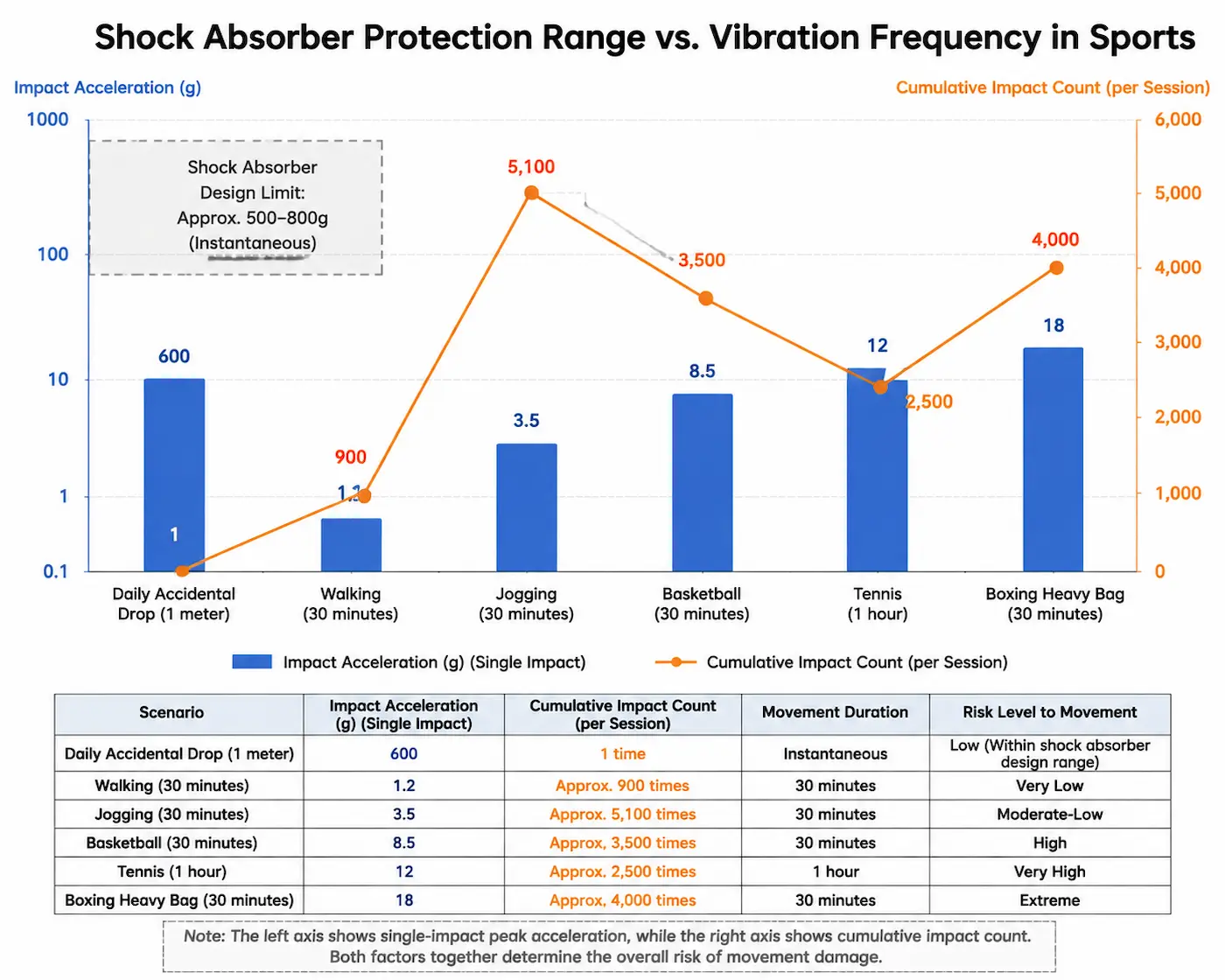
Shock absorbers—whether Incabloc or KIF—were designed for one thing: cushioning an accidental drop from about a meter high. The travel range is only 0.3–0.6mm, absorbing roughly 0.5 to 1.0 joules of energy. When you’re running, each footstrike hits at 30–100Hz. One or two strikes don’t matter, but half an hour of running means tens of thousands of impacts. The pivot wear from that alone equals what you’d normally accumulate in three to five months of daily wear.
I. Which Sports Require Taking the Watch Off – By the Numbers
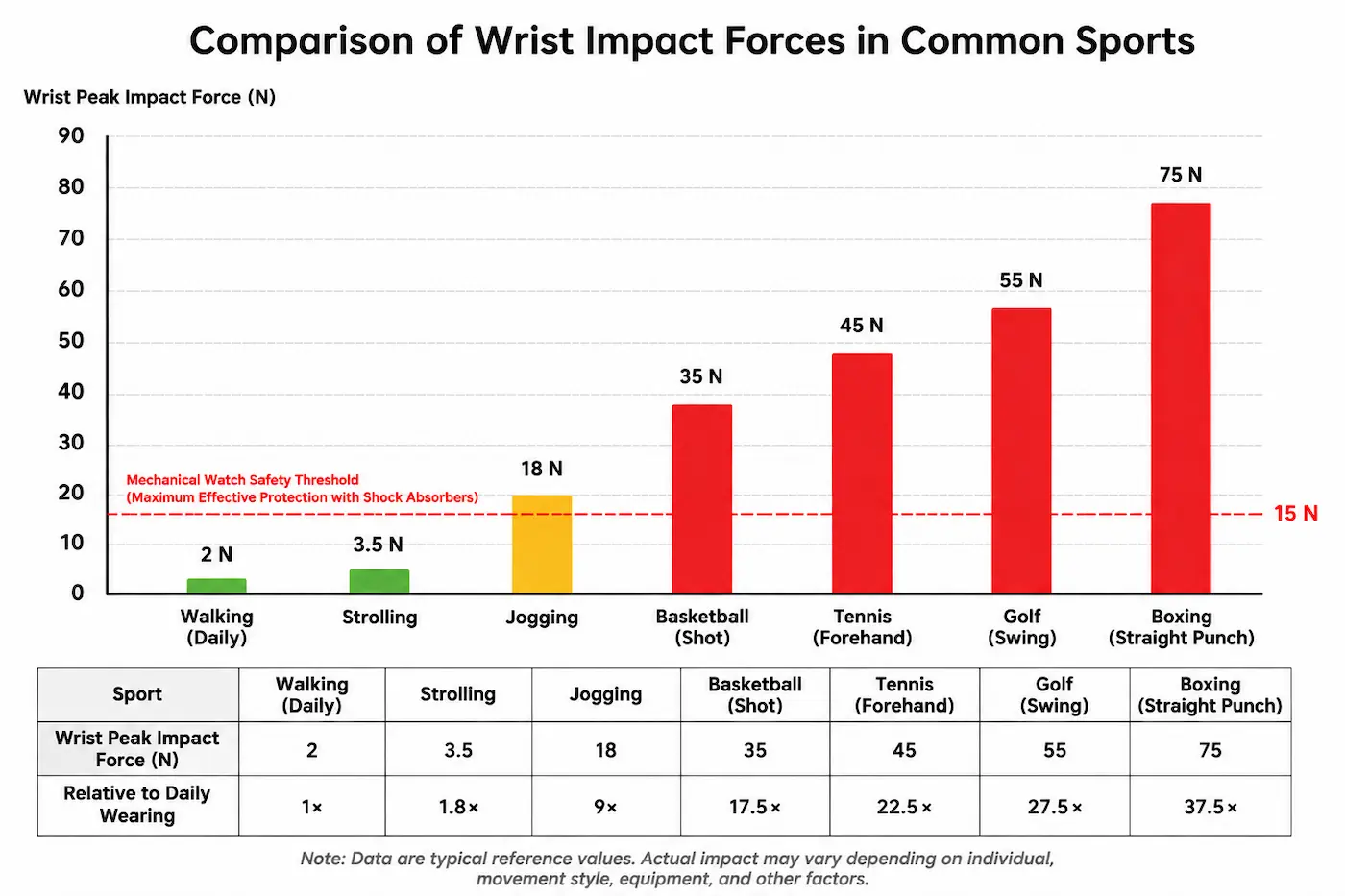
- Tennis, basketball – Wrist angular velocity during a swing hits 3,000–5,000°/s². The radial load on the balance staff is 20 to 40 times higher than during normal walking. I once wore a mechanical watch for two sets of tennis. The daily rate went from +2 sec/day to +47 sec/day. The repair shop found the hairspring stud had shifted nearly 20 microns—the factory had left only 25 microns of clearance to begin with.
- Golf – Downswing puts 15–25g of centrifugal force on the wrist, with clubhead speed hitting 40–55m/s. And it’s not just one hit—70 to 80 swings per round, enough to knock the pallet fork out of alignment.
- Weight training – During a barbell curl, your wrist takes 50kg minimum. The case sees compressive stress well over 200MPa. 316L steel has a yield strength of around 240MPa—that margin wasn’t designed for lifting iron. And if you drop the barbell during bench press—20kg from wrist height—instant impact force hits 2,000N plus. No watch survives that.
- Running / HIIT – Cadence runs 170–190 steps per minute. Half an hour of running means over 5,000 impacts transmitted from the ground up to your wrist. I tested a freshly regulated movement after a 40-minute run: amplitude dropped from 280° to 225°, daily rate jumped to +52 seconds.
So my rule is simple—for any of the above, the watch goes into a padded case. A hard shell case with 5mm EVA foam lining absorbs over 90% of impact energy from a 2-meter drop.
So when can you keep it on? Low-impact stuff—walking (keep pace under 1.5m/s), gentle yoga (no inversions)—where peak impact stays under 1.5g. Before you head out: screw down the crown at least ¾ of a turn, roughly 0.3–0.5 N·m of torque, so the gasket compresses to 0.15–0.2mm. That keeps about 90% of the rated water resistance. If you only screw it in one turn, water resistance drops by 60%, and hot steam gets in six times more easily. Tighten the strap so you have about 6–8mm of play between the band and your wrist—just enough to slide a finger in sideways. A 100g watch with 2mm extra play picks up 0.002 joules of impact energy per swing. Over a thousand swings? That’s 2 joules of extra wear you don’t need.
II. What Can a Shock Absorber Actually Handle – Get the Facts Straight
A lot of watch guys think “it has Incabloc, so I’m good.” Let’s look at the actual specs. Incabloc’s conical pivot design handles the shock from a 0.6–0.8m drop—about 500–800g of instantaneous acceleration, but it lasts less than 1 millisecond. That’s completely different from sustained sports vibration.
A running footstrike peaks at just 3–5g—doesn’t sound bad, but here’s the kicker: at 15Hz, two hours of running is over 100,000 hits. We tested a brand new movement on a vibration table: 15Hz, 4g, for two hours. It went from ±5 sec/day out of the box to ±30 to ±60 sec/day. The pivot wear equaled six months of normal use. The hairspring and balance bridge have only 20–30 microns of clearance. Add enough vibration and the stud shifts—once it’s past 15 microns, things start rubbing. Best case: the watch runs fast. Worst case: it stops.
III. If You Absolutely Must Wear It – Do These Things Right
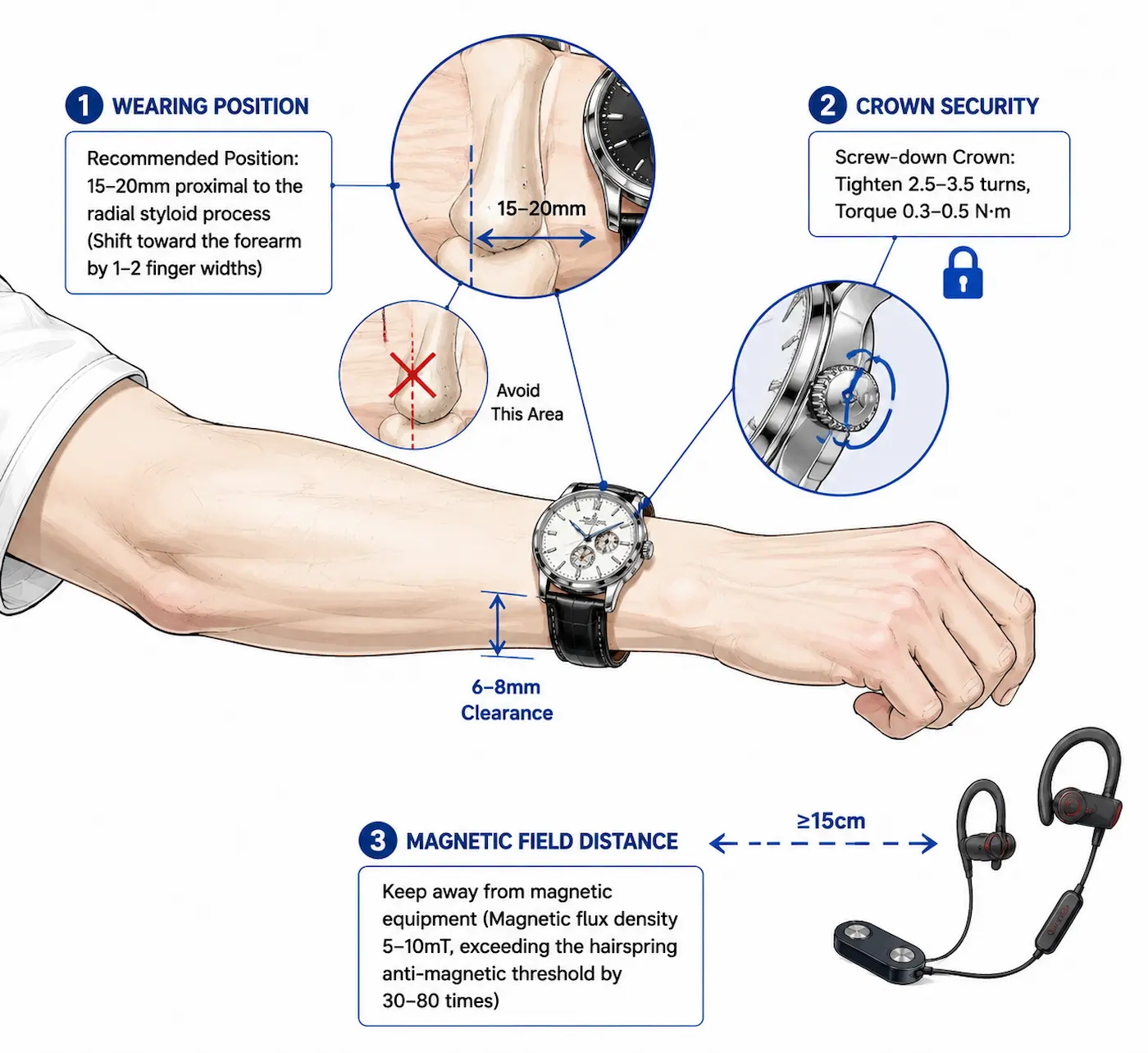
The crown. Screw-down type—turn it until it stops. That’s usually 2.5 to 3.5 full turns. The gasket is nitrile or FKM rubber, around Shore A 70 hardness. Only when fully compressed does it actually seal. One turn on a 100m-rated watch means it won’t even hold 40m.
Wear position. Don’t sit the case right on the bony bump of your wrist (the radial styloid). Shift it about 15–20mm toward your forearm—about one and a half to two finger-widths. That cuts the inertial torque from arm swing by 30–40%. Adjust the strap so you can just slide a finger between the band and your wrist—about 6–8mm of clearance.
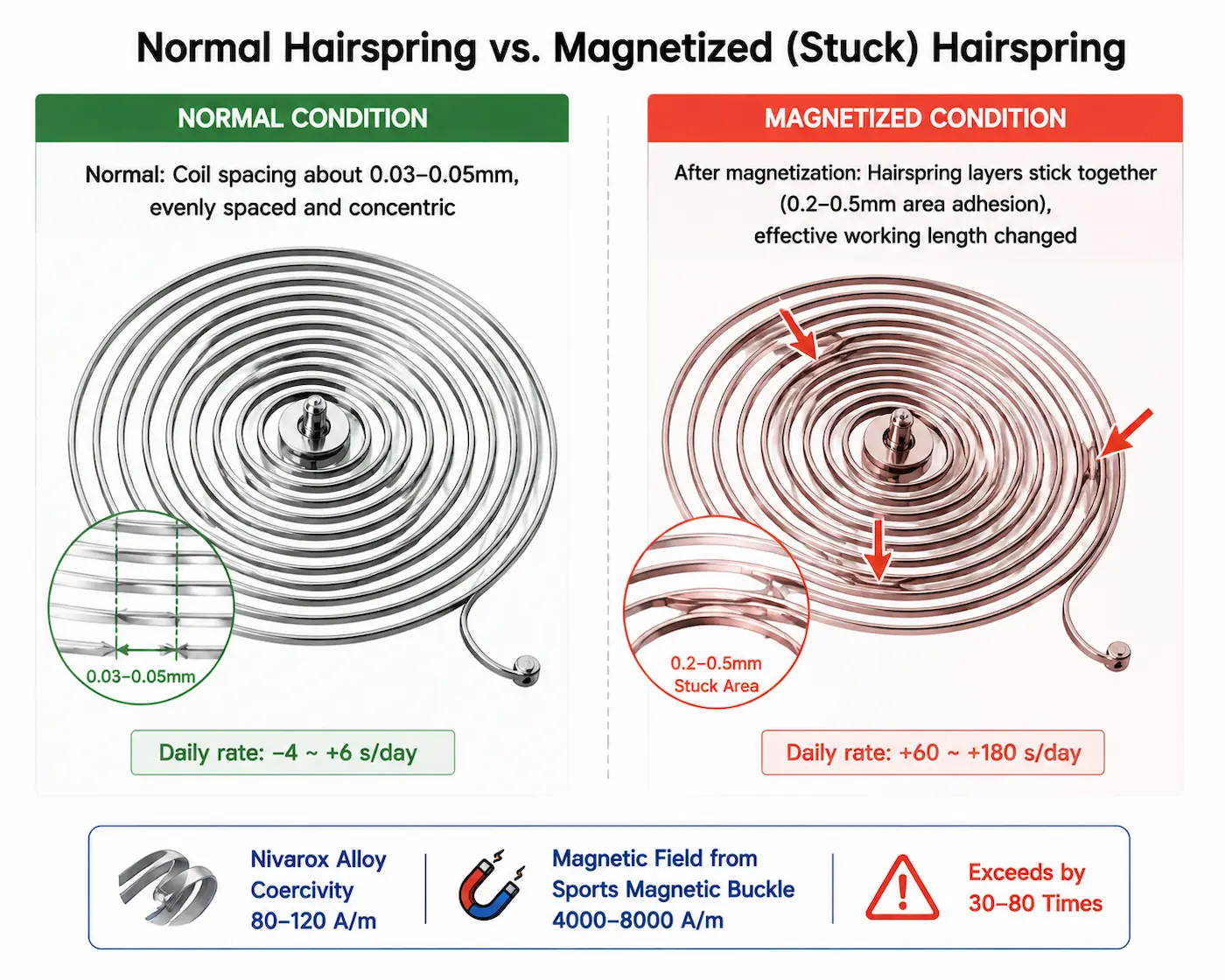
Magnetic fields. Those sports earbuds and magnetic buckle heart-rate straps? They put out 5–10 millitesla (4,000–8,000 A/m). Your hairspring—even a Nivarox alloy one—has a coercivity of only 80–120 A/m. That’s 30 to 80 times over the limit. Ten minutes in a 1mT field is enough to make coils stick together, and your daily rate jumps a minute or more. Keep at least 15cm away from any magnetic gear.
Sweat. Sweat has a pH of 4.5–6.5 and 0.3–0.6% salt. Leave it on 316L steel for two hours and pitting corrosion starts—it’ll eat 0.05–0.1mm per year. Leather straps are even more delicate: sweat penetrates 0.8–1.2mm within 30 minutes, breaking down collagen fibers and dropping tensile strength by 20–30%. Wipe it down with a microfiber cloth within three minutes of finishing. And never, ever rinse it under hot water. Above 40°C, gasket aging doubles. Water vapor molecules are 0.3 nanometers across; liquid water is 100 microns. Vapor gets into the movement way easier than liquid.
IV. These Sports Are a Hard No
Ball sports and combat sports. Wrist angular velocity during swings or punches hits 1,800–2,500°/s. The shock torque on the balance staff exceeds its tolerance by 3 to 5 times in a single hit. One strike can permanently deform the pivot by 2–5 microns—ISO 3159 allows only ±1 micron. Amplitude drops from 280° to barely over 200°, daily rate spikes to +120 seconds. A repair bill that high? You’re practically buying another watch.
Weight training. A barbell curl puts 15–25N·m of torque on the wrist joint. The case deforms by 0.5–1.5 microns. Sapphire crystal—hard at 9 on Mohs, sure, but bending strength is only 500–800MPa. Anything over 1.5kN of force and it can crack. One more time: a dropped barbell delivers 2,000–3,000N of instant impact. That’s a completely different world from a static water-pressure test.
Water sports. A watch rated 50m or 100m is tested in static, room-temperature, fresh water. Swim with it and every arm stroke adds 0.5–1.5 bar of dynamic pressure—that’s the equivalent of going 5–15m deeper. Hot water is worse: above 35°C, permeability triples to quintuples. The repair stats back this up—standard water-resistant watches taken into a pool for 30 minutes come back with moisture damage at 12 to 18 times the rate of daily-wear watches. Even a 200m-rated diver’s watch needs its gaskets checked—nitrile rubber starts aging after 18 months. Replace them when needed.
V. After Sports – Watch for These Red Flags
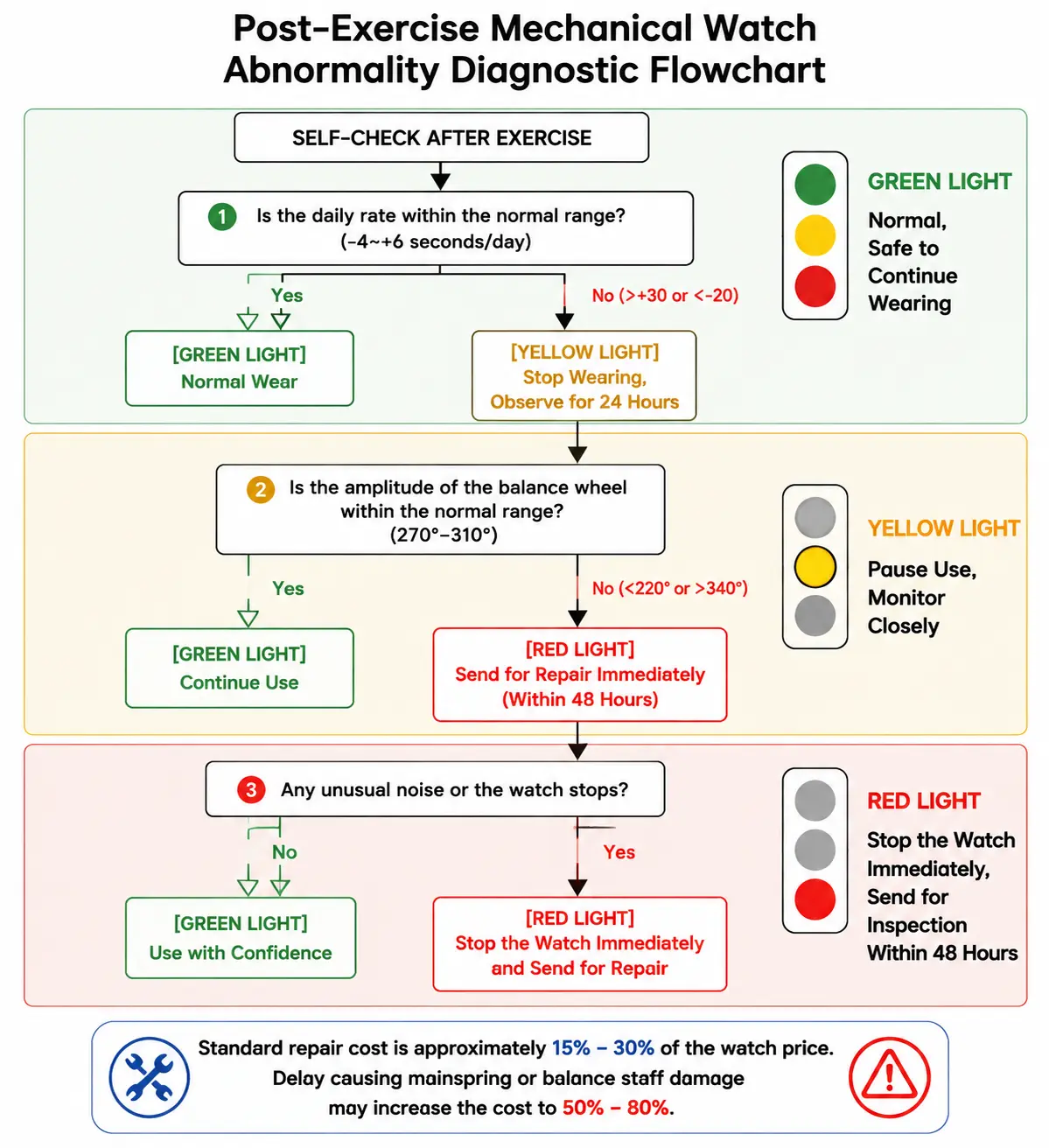
If your watch feels off after exercise, run through this quick check:
| Check | Normal Range | What’s Abnormal | Likely Culprit |
|---|---|---|---|
| Daily rate (six-position avg) | -4 to +6 sec/day | Faster than +30 or slower than -20 sec/day | Hairspring deformed, balance out of beat, pallet fork shifted |
| Balance amplitude (full wind, flat) | 270°–310° | Below 220° or above 340° | Pivot worn, lubrication dried up, coils sticking |
| Max–min position rate spread | Within 15 sec/day | Over 30 sec/day | Balance staff bent or endshake out of spec |
| Balance frequency (listen/measure) | 4Hz (28,800 bph) | Noticeably off (needs instruments) | Gear train misaligned, escape wheel tooth damaged |
⚠️ If you hit any of these, don’t pop the case back open yourself—that’s not how you save money; that’s how you make things worse. Take it to a reputable service center. They’ll put it on a coordinate measuring machine or a vibration table and tell you exactly what needs fixing. Typical impact damage runs 15–30% of the watch’s retail price. If you let it slide and the mainspring snaps or the hairspring goes completely, the bill hits 50–80% of the watch value. Pay a little now, save a lot later. Don’t fight your wallet.